Ohm’s Law connects three basic ideas — Voltage, Current, and Resistance — into one simple relationship: V = I × R. This lesson keeps the language plain, with colourful analogies and diagrams.
Three ideas, one law
Every circuit has a push (voltage), a flow (current), and some opposition (resistance). Ohm’s Law says how those three stick together — so if you know any two, you can find the third.
Voltage (V)
The push that makes charge move. Measured in volts.
Current (I)
How much charge is flowing. Measured in amperes (amps).
Resistance (R)
How hard it is for current to flow. Measured in ohms (Ω).
What is Voltage?
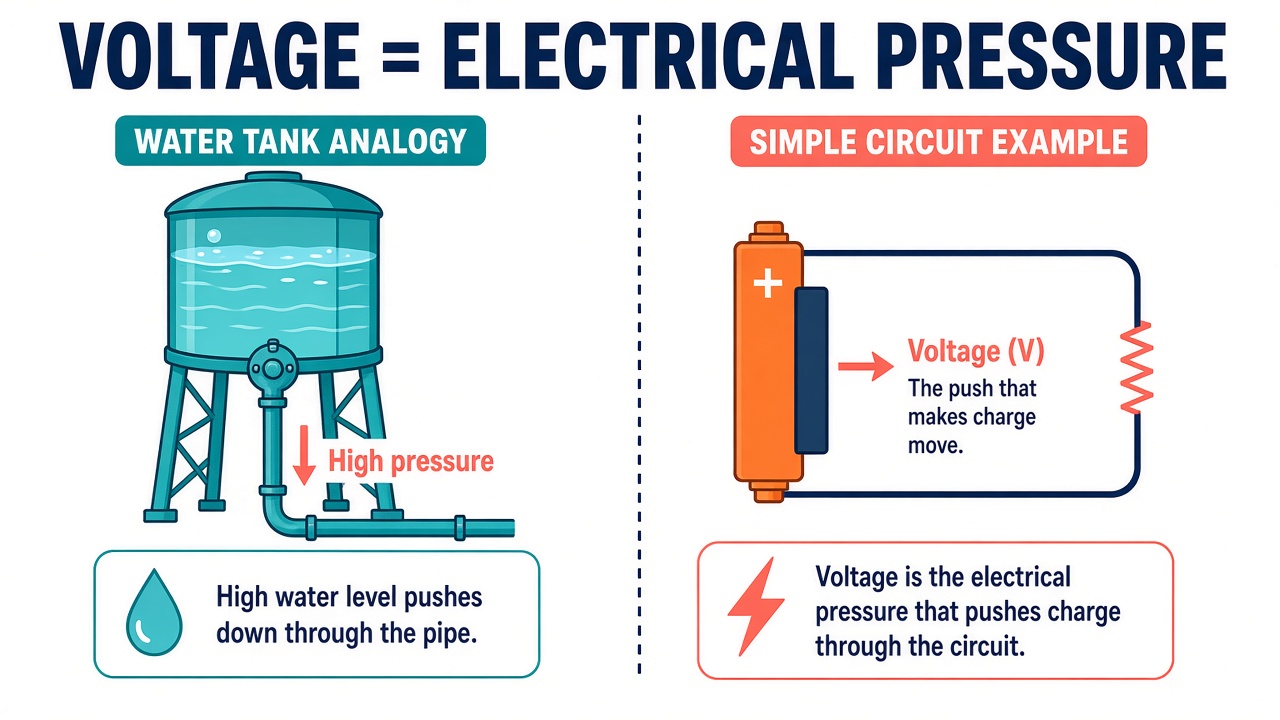
Think of a water tower. A high water level pushes hard down the pipe — that push is like voltage. In a circuit, the battery (or power supply) provides the electrical “pressure” that pushes charge along the wires.
Voltage is the electrical pressure that pushes charge through the circuit.
What is Current?
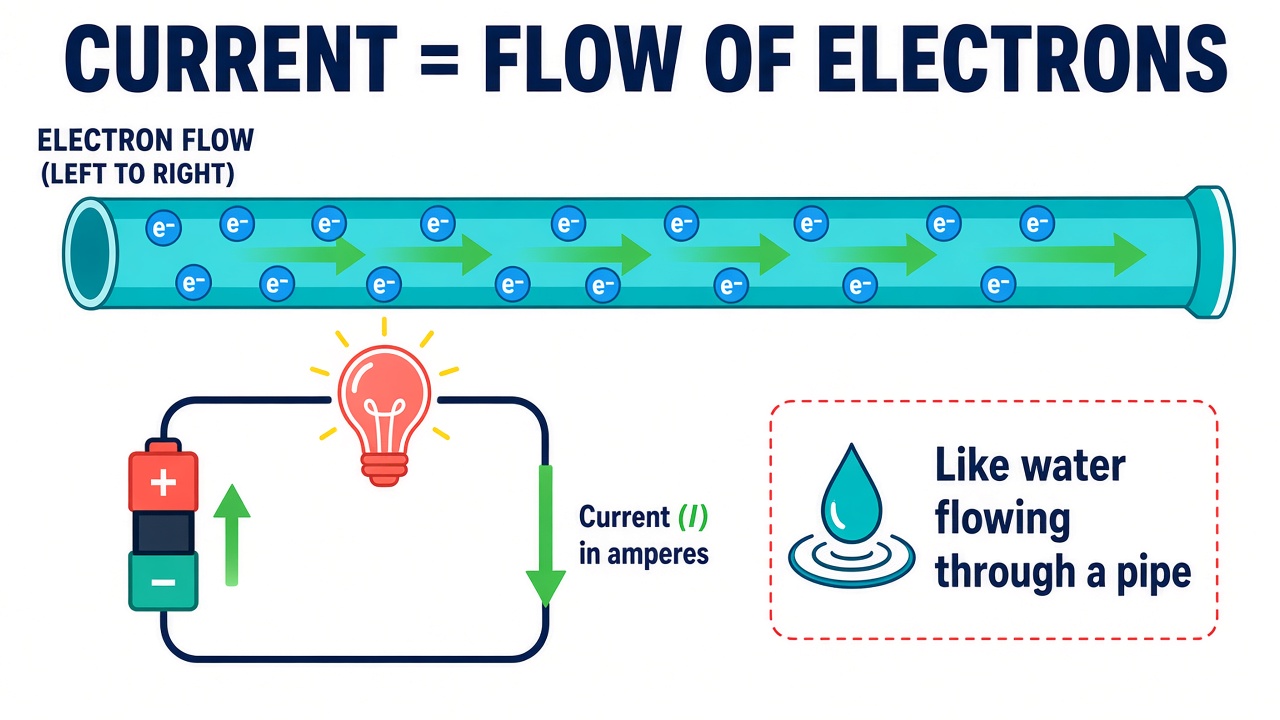
Current is the flow of electrons (charge) through a wire — like water flowing through a pipe. More flow means more current. We measure it in amperes (A), often written as milliamps (mA) in small circuits.
Current is the amount of charge flowing past a point each second.
What is Resistance?
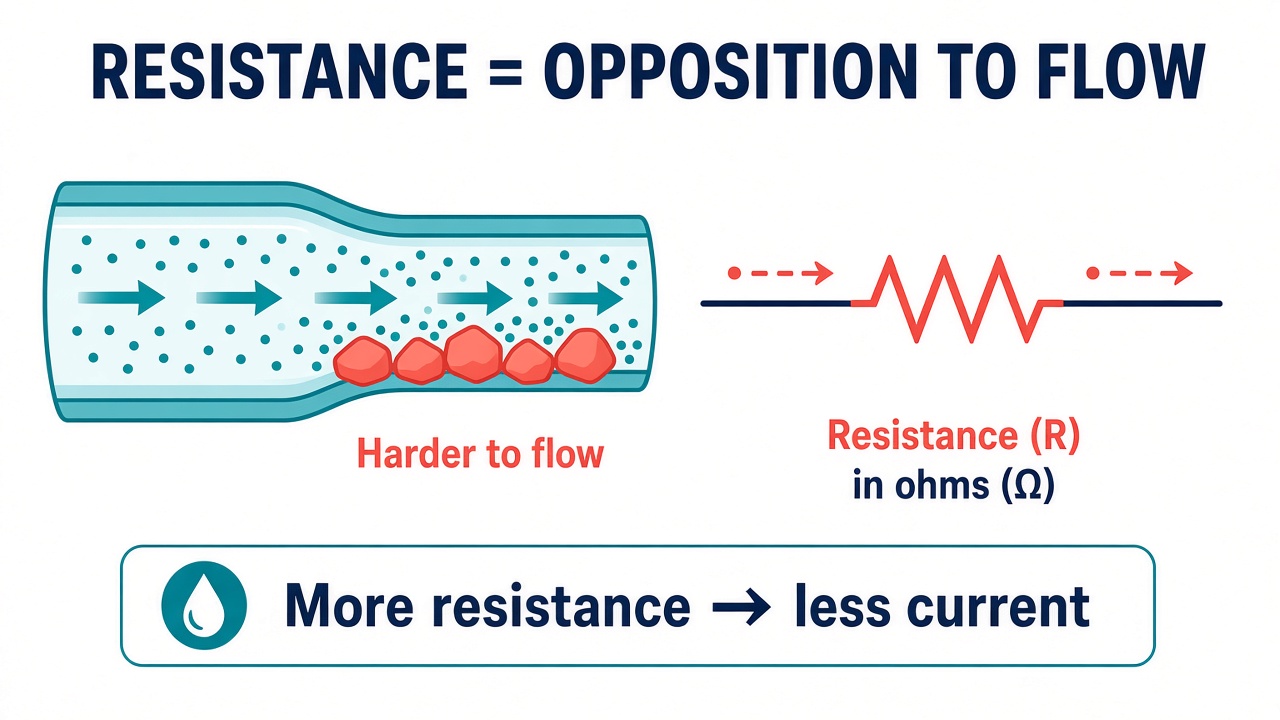
Resistance is opposition to that flow. A narrow, rocky pipe slows water; a resistor (or a long thin wire, or an LED) slows current. Higher resistance → less current for the same voltage. Unit: ohms (Ω).
More resistance means less current for the same voltage.
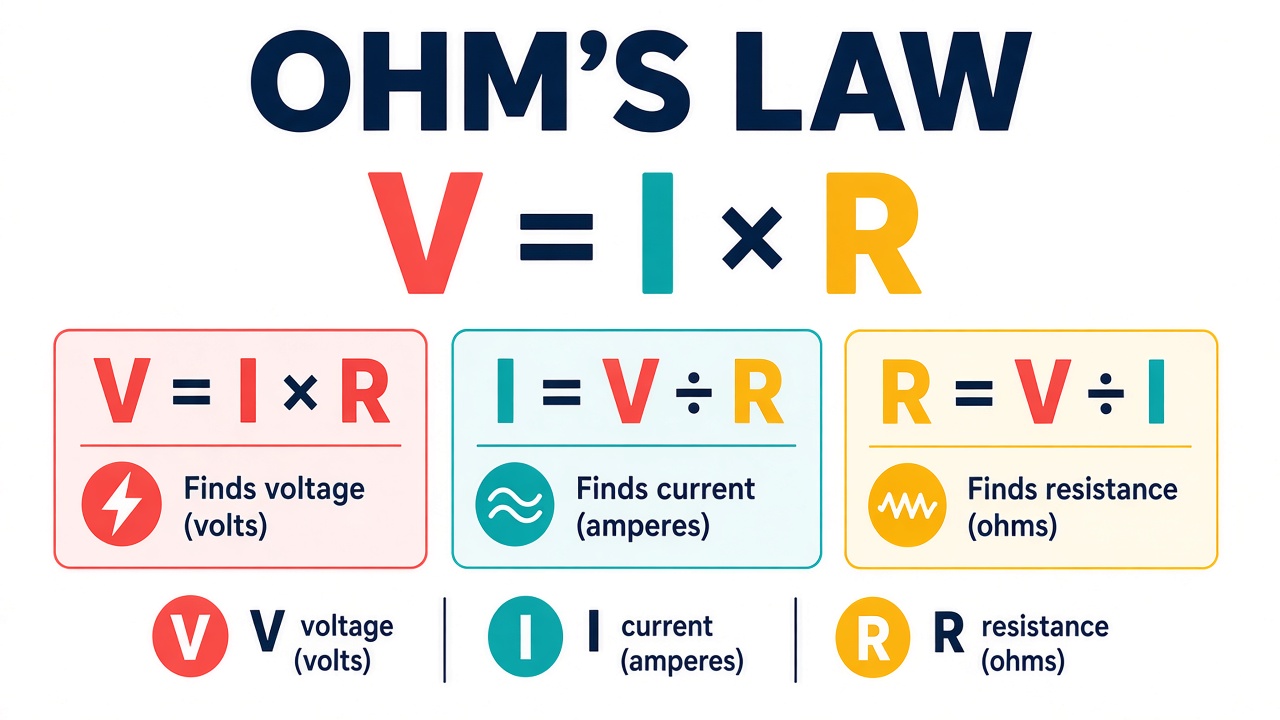
Ohm’s Law: V = I × R
Put the three together and you get Ohm’s Law. Voltage equals current times resistance. You can rearrange it to find whichever value you are missing.
Main form: V = I × R. Also: I = V ÷ R and R = V ÷ I.
I = V ÷ R
Find current when you know voltage and resistance.
R = V ÷ I
Find resistance when you know voltage and current.
A simple example
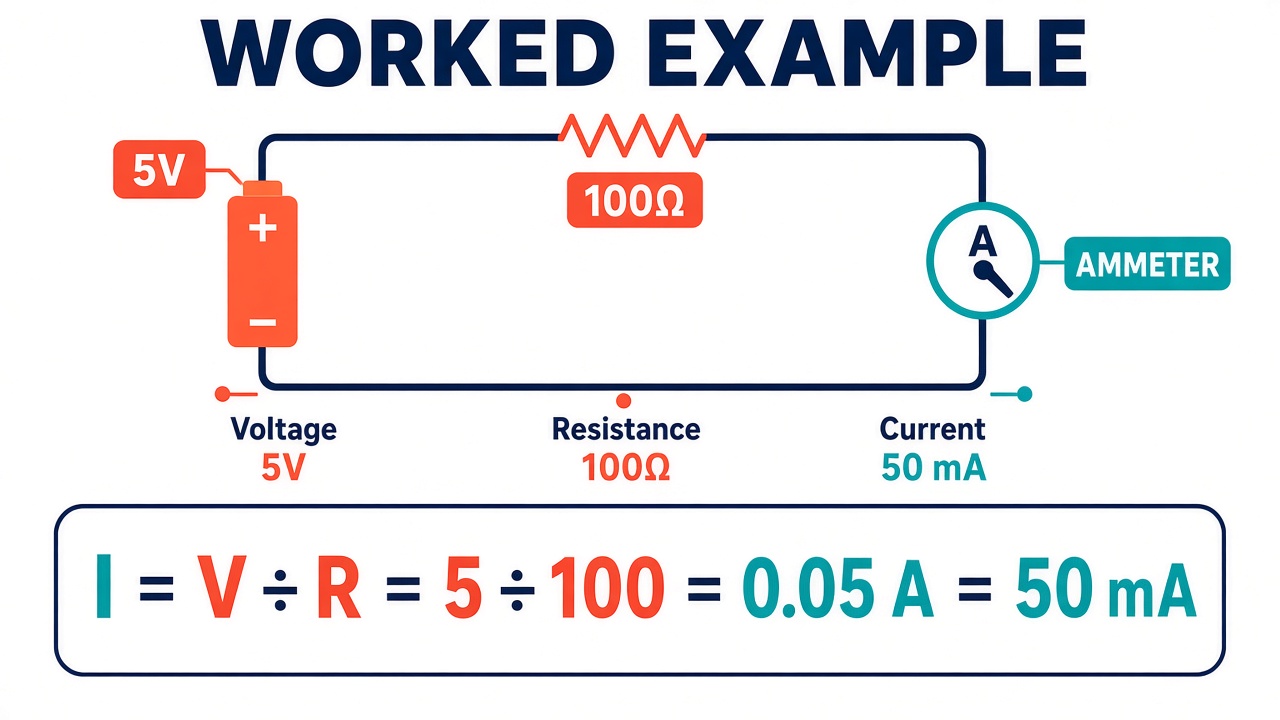
A 5 V battery feeds a 100 Ω resistor. How much current flows?
I = V ÷ R = 5 ÷ 100 = 0.05 A = 50 mA.
Same voltage, higher resistance → smaller current. Same resistance, higher voltage → larger current.
One real-life tip
In one sentence: always add a series resistor with an LED so Ohm’s Law keeps the current safe — without it, the LED can draw too much current and burn out.
Try it: LED + series resistor
Flip the switch. When the circuit is closed, current flows from the battery, through the resistor (which limits the current), and lights the LED. Open the switch and the flow stops — the LED goes dark.
Battery (V) → switch → resistor (R) → LED → back to battery.
Circuit open — no current. Flip the switch to close it.